
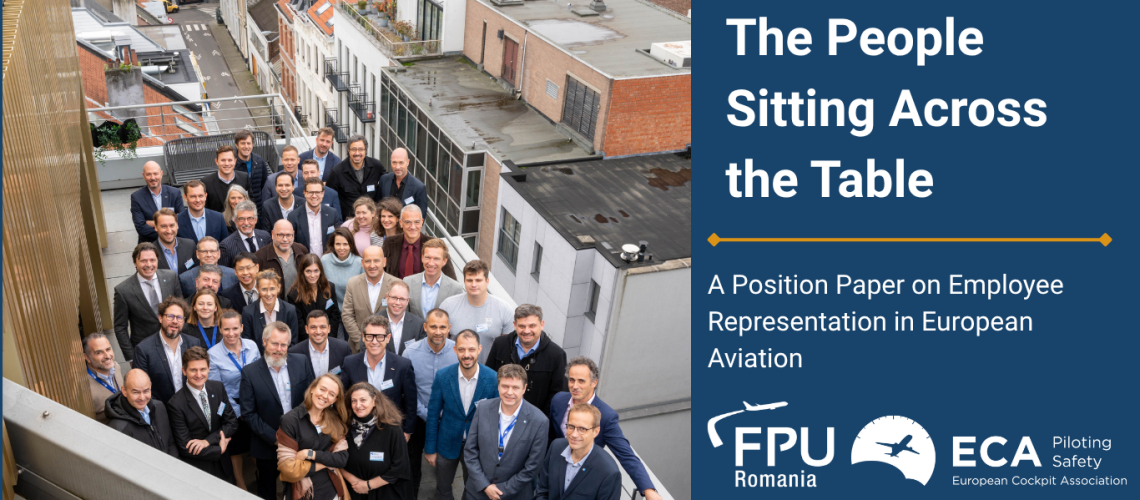
From Berlin to Brussels, and from Stockholm to Sofia, employee representatives across the European aviation industry continue to report increasing pressure associated with carrying out legitimate representative activities.
The facts of individual cases differ. They should be assessed through the appropriate procedures and processes, and FPU Romania does not comment on the merits of ongoing disciplinary proceedings, employment disputes or individual cases.
However, the broader trend itself deserves discussion.
For many years, tensions surrounding trade union activity and employee representation were often perceived as challenges affecting only certain parts of Europe. Recent developments suggest that this assumption deserves to be revisited and raises an important question for the future of employee representation in European aviation:
What happens when the people sitting across the table decide that sitting at the table is no longer worth the risk?
Leadership Matters
Employee representatives and trade union representatives must be able to carry out their representative duties without fear that the role itself becomes a source of personal risk or pressure. This principle matters because representation comes with responsibility and, naturally, it also requires some sort of protection.
Airlines invest heavily in executives and managers who are expected to make difficult decisions in the interests of the business. Modern trade unions operate in much the same way.
Employee representatives are elected, trusted, and mandated by their colleagues to defend collective interests, advance priorities identified by their members, and engage in negotiations and representative activities that are often complex, difficult, and highly pressured.
Like any leadership role, representation requires judgment, resilience, and accountability.
Employee representatives are not spectators sitting around the table. They are one of the reasons there is a table in the first place.
From East to West: A European Experience
For many employee representatives across Central and Eastern Europe, difficult labour relations, resistance to employee representation and prolonged disputes are not unfamiliar experiences.
What experience has shown, however, is that these challenges are neither regional nor new.
Strong employee representation is not built because negotiations are easy. Strong employee representation is built because employee representatives and their members continue to engage, organize, and negotiate even when discussions become difficult, prolonged, or reach temporary deadlock.
Determination prevails.
Over time, experience has consistently demonstrated that persistence, professionalism and genuine negotiations ultimately produce stronger agreements, more mature labour relations and more sustainable outcomes for both employees and employers.
Recent developments across Europe suggest that this is not an Eastern European story anymore.
It is a European one.
The People Across the Table
The people sitting across the table are not professional negotiators by default. They are pilots, cabin crew members and employees who accepted a mandate from their colleagues.
They negotiate. They organise. They challenge. They compromise. They disagree.
Then they return to the operation they help negotiate and live with the agreements they help conclude.
Employee representatives do not represent themselves. They represent the collective mandate entrusted to them by their colleagues. For this reason, actions affecting employee representatives inevitably resonate far beyond the individuals concerned.
This should concern not only the employee representatives but especially the airlines.
Trade union leaders are not an obstacle to durable agreements. In many cases, they are the people capable of delivering them.
Likewise, difficult negotiations, disagreement, and even temporary deadlock should not automatically be viewed as a failure of employee representation or collective negotiations. In many cases, they are evidence that meaningful negotiations are actually taking place.
The strongest agreements are rarely the easiest to negotiate. At the same time, employee representatives should never become part of the negotiation strategy itself. Actions perceived as placing disproportionate pressure on employee representatives may carry consequences extending far beyond any individual dispute, including weakened trust, more difficult negotiations, and less sustainable agreements over time.
The FPUR Position
FPU Romania believes that trade union representatives must be able to carry out legitimate representative activities freely, professionally, and in good faith, without fear that their representative role itself becomes a source of personal risk or pressure.
Because modern aviation requires strong leaders on all sides of the table. And strong leadership can only exist where respect, trust, and good faith remain stronger than disagreement itself.
